
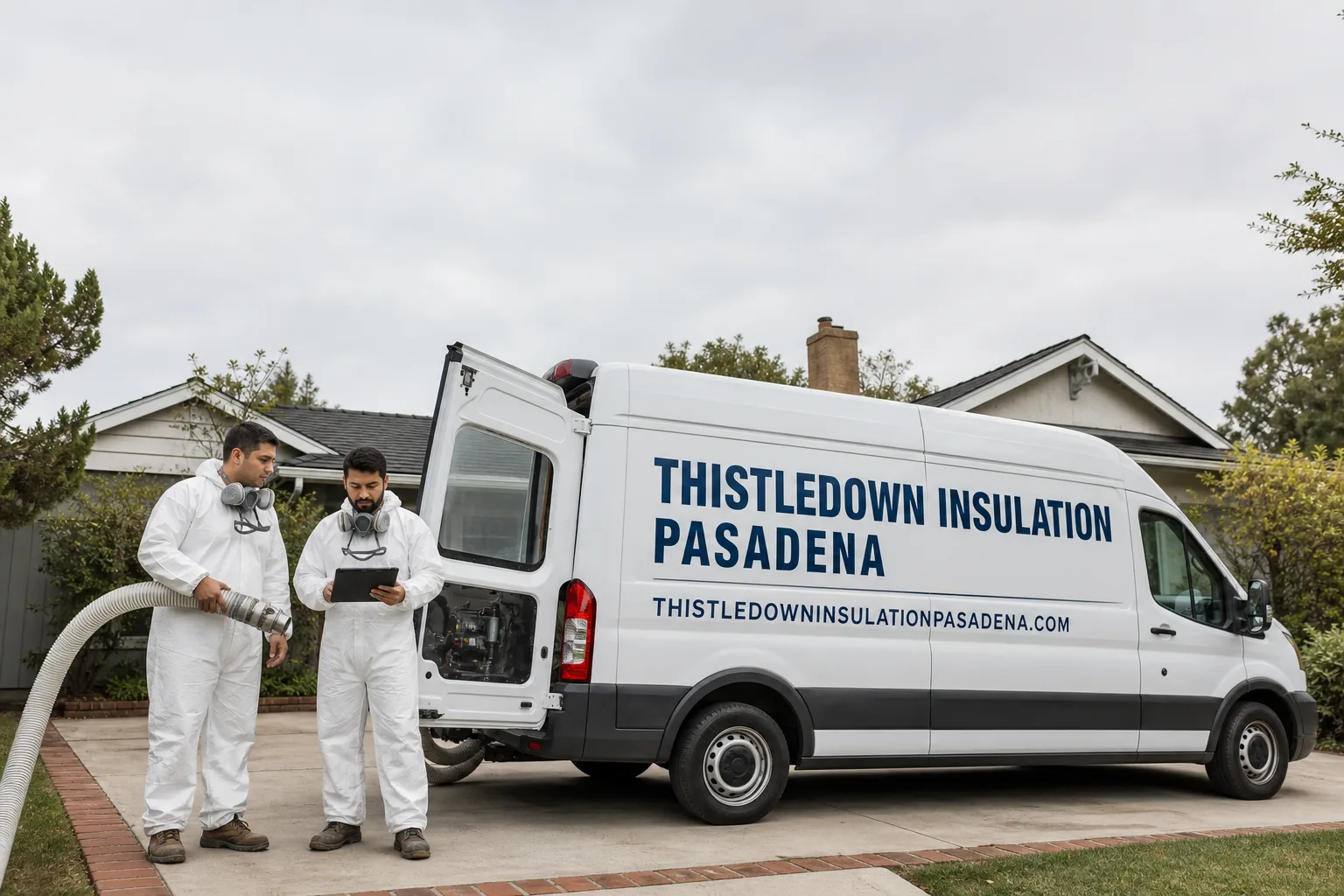
Fast, Reliable Attic Insulation Across Arcadia
Attic insulation in Arcadia usually costs between $1,800 and $4,200 for a full retrofit, with top-ups running $900 – $2,100 and radiant barrier adding $1,200 – $2,600. Most jobs take one day, and we’re typically in your Arcadia neighborhood within 24 – 48 hours of your call. Our team knows exactly what happens inside a 1960s Arcadia attic after fifty-plus years of San Gabriel Valley heat, and we’ll give you a written price before anyone opens the attic hatch. For a free estimate, call (626) 657-5343.
Why Thistledown Insulation Pasadena Is Arcadia’s Preferred Attic Insulation Company
We’re a Cedarwell-family company, and our crews work through Arcadia’s ranch homes, split-levels, and newer builds every week. Homeowners here tend to ask the same questions: Will the product be safe for the baby’s room? Will the hallway be clean when you leave? Will the written price match the invoice? Our answers are always yes, yes, and yes, because those aren’t optional add-ons, they’re the job.
Neil Barron, who leads our team, has built a crew that works the way Arcadia families expect: background-checked, uniformed, and careful. We lay drop cloths across your hallway and wear shoe covers from the front door to the attic hatch. Before we leave, we photograph the clean-up so you can see what we did even if you weren’t home. A live person answers our phones 24/7, so when a July heatwave hits and your upstairs bedrooms feel like a sauna, you reach a human, not a voicemail tree.
Every installation is backed by the 365-Day Done Right Promise. If it’s not done right, we make it right, no debate, no fine print. That promise matters in Arcadia, where older attics often hide surprises: settled cellulose, compressed batts, or vermiculite no one mentioned when you bought the house. You’ll know the full picture before we start, and the written price covers what we agreed to.
Attic Ventilation in Arcadia
Attic Ventilation in Arcadia is the difference between an attic that quietly releases heat and an attic that bakes your ceiling drywall into a radiator by 4 p.m. Homes here, especially those built in the 1950s through 1970s, often came with a single gable vent or a few passive roof vents sized for a different climate. When temperatures push past 100°F, attic spaces can exceed 150°F. That superheated air radiates into bedrooms and forces your air conditioner to work much harder. For most Arcadia homes, upgrading attic ventilation costs between $600 and $1,900 depending on attic size, roof style, and whether electrical work is needed for powered units. Low-slope roofs common in parts of Arcadia often need a different vent configuration than steep-pitch roofs, and we’ll explain which approach fits your house before any work begins.
Solar-Powered Attic Vents
Solar-powered vents make particular sense in Arcadia because they run hardest exactly when your attic is hottest: during the peak afternoon sun. Unlike thermostatically controlled electric fans, solar units don’t add load to your panel, which matters in older Arcadia homes where the electrical service may already be near capacity. They also work silently, an advantage for families with light sleepers in rooms directly below the roofline.
Air Sealing Before Ventilation
Ventilation without air sealing is like opening a window while the door’s still shut: the math doesn’t work. Before we add vents, we seal the gaps around top plates, can lights, and wiring penetrations. In Arcadia’s 1960s ranches south of Huntington Drive, these gaps often span entire wall cavities, letting conditioned air escape into the attic year-round. Sealing them is quiet work, and we can do it while the kids nap.
Radiant Barrier in Arcadia
Radiant Barrier in Arcadia is a low-cost multiplier for whatever insulation you already have. It’s a reflective foil layer installed under your roof deck that bounces radiant heat back toward the roof instead of letting it soak into the attic floor insulation. In a climate with months of direct sun and attic temps regularly exceeding 150°F, a radiant barrier can cut attic heat transfer by a measurable amount, especially on low-slope or gable-roofed homes without much ridge venting. Radiant barrier installation in Arcadia typically ranges from $1,200 to $2,600 depending on attic square footage and how much of the roof deck is accessible. It doesn’t replace insulation; it works alongside it, keeping the insulation itself cooler so it performs closer to its rated R-value.
Under-Deck Foil Installation
We staple the foil directly to the underside of the roof sheathing, leaving an air gap between the foil and the deck, which is essential for the reflective performance to work. In Arcadia’s many ranch homes with shallow attics, this method doesn’t take up any floor space and doesn’t interfere with existing blown-in cellulose. The work itself is quiet, and we clean up as thoroughly as we would in our own homes.
Pairing Radiant Barrier With Insulation Upgrades
For attics where the insulation has degraded, pairing a radiant barrier with a cellulose or fiberglass upgrade gives you a full thermal package: the barrier handles the sun’s direct heat, and the insulation handles conductive heat rising from the home below. In the 1962 ranch on Lemon Avenue we recently upgraded, the homeowner saw a 12°F drop in bedroom temperatures during the next heatwave after we installed this combination plus two solar-powered vents.
Trusted Brands We Service in Arcadia
We install eight insulation brands, including Owens Corning, GreenFiber, Johns Manville, and Knauf, and we match the product to the attic and the family living beneath it. For Arcadia’s older homes with vermiculite concerns or pet-sensitive households, we often recommend GreenFiber cellulose, a borate-treated product with good fire resistance and a lower irritant profile than raw fiberglass. Where a homeowner prefers a familiar name with decades of test data, we stock Owens Corning and Johns Manville batts for easy comparison. Because we keep common materials staged for Arcadia-area jobs, we can usually begin work within a day or two of your written estimate, not a week or more.
Common Attic Insulation Problems We See in Arcadia Homes
- Compressed fiberglass batts in 1960s ranches. The original Owens Corning pink batts installed in Arcadia homes built before the 1980s were often R-11 or less, and after decades of heat and occasional wildlife traffic, they sit compressed to half their rated thickness. Compressed fiberglass loses R-value quickly, which is why a 1962 home in Arcadia may have “insulation” that performs barely above an uninsulated attic.
- Cellulose drift south of Huntington Drive. In the 1960s-era homes south of Huntington Drive, shallow attic ceilings and loose-fill cellulose installed decades ago mean the material has migrated away from the eaves. We’ve found bare spots the size of a bathroom rug directly above bedroom ceilings, which turns those rooms into ovens by mid-July. We look for this failure pattern on every Arcadia inspection because it’s so common in this specific housing stock.
- Vermiculite in pre-1970s attics. Some Arcadia homes built before 1970 still have vermiculite insulation, which may contain asbestos. This isn’t something to disturb without testing. We’ll identify it, recommend a certified testing protocol, and only proceed once the attic is safe to work in. If abatement is needed, we’ll coordinate that separately before any insulation upgrade begins.
- Thermal voids around top plates and can lights. Even in newer Arcadia builds, gaps where walls meet the attic floor allow hot attic air to infiltrate the living space. In a 1970s Arcadia home with original 2×4 wall framing and R-11 insulation, the ceiling junction is often the single largest unsealed area in the whole house. Air sealing fixes this, and it’s typically a one-day job.
Pricing for Attic Insulation in Arcadia, CA
You’ll get a written price before we start, and here are the typical ranges for Arcadia homes: a full attic insulation replacement with air sealing runs $2,800 – $4,200 for a 1,200 – 1,800 sq ft ranch. A top-up of existing insulation runs $900 – $2,100 depending on material and R-value target. Attic baffles and ventilation prep add $400 – $900, and a radiant barrier adds $1,200 – $2,600. What moves the number: attic accessibility, vermiculite testing or abatement if needed, whether we’re topping up or fully removing old material, and the R-value you want. Older Arcadia homes often need full removal because the original insulation has settled, compressed, or drifted. Newer homes typically need only a top-up and air sealing. A free estimate takes about 45 minutes in your attic, and our price is always in writing before any work starts. Call (626) 657-5343 and we’ll schedule a visit.
Want a quick answer first? Here’s the honest version: most Arcadia retrofits land between $2,500 and $3,800, and the estimate is free regardless.
We Also Serve Cities Near Arcadia
Our crews serve the San Gabriel Valley and nearby foothill communities, including Arcadia itself, Monrovia, Sierra Madre, Duarte, and Baldwin Park. If you’re in a neighboring city and dealing with the same heat-driven attic problems we see throughout the area, call us and we’ll schedule a visit. Dispatch and scheduling are coordinated from our Los Angeles office, and crews serve Arcadia locally. If you need our full Attic Insulation services anywhere in the region, we’ll send a background-checked technician to take a look.
Serving Arcadia, CA - Our Local Coverage Area
We’re based in the Arcadia area and know this community well. Use the map below to see our service coverage - if you’re nearby, we can almost certainly help.
FAQs About Attic Insulation in Arcadia
Extended heat accelerates the degradation of fiberglass and cellulose insulation by driving out moisture and causing the material to settle faster. In Arcadia, where triple-digit days happen every summer and attic temperatures regularly exceed 150°F, insulation that was installed with a 20- to 30-year expected life often loses meaningful R-value within 12 to 18 years. The heat also makes any existing air leaks along the eaves and top plates more consequential, because hot air pushes harder through every gap. A quick attic inspection can tell you whether your insulation is still doing its job. Call (626) 657-5343 and we’ll check it out.
Don’t disturb it, and don’t attempt to remove it yourself. Vermiculite from that era may contain asbestos, and the only safe path is professional testing first. We’ll identify the material during our inspection and refer you to a certified asbestos testing lab. If the test comes back positive, abatement must happen before any insulation upgrade, and we’ll coordinate that with a licensed abatement contractor. Once the attic is cleared, we can proceed with air sealing and new insulation on a normal timeline. Call (626) 657-5343 and we’ll walk you through the process.
In that specific pocket of Arcadia, the original blown-in cellulose has often drifted away from the eaves, leaving bare thermal voids directly above bedroom ceilings. That means the insulation you do have isn’t covering the place where the heat builds up most. We’ve seen this pattern enough times that we automatically inspect the eave line on every 1960s home south of Huntington, not just the center of the attic. The fix is usually a combination of re-installing cellulose along the eave line, air sealing, and adding ventilation. Call (626) 657-5343 and we’ll schedule an inspection so you can see exactly what’s happening up there.
In most cases, yes. Low-slope roofs have less internal attic volume, which means the ceiling is physically closer to the roof deck and the attic air heats up faster. A radiant barrier reflects that incoming heat before it can radiate onto the attic floor insulation, and the effect is most pronounced on sunny afternoons when your air conditioner is already working hardest. We’ve measured the difference on Arcadia homes after installation, and the combination of cooler attics and reduced AC runtime typically pays for the barrier within a few summers. For a written quote, call (626) 657-5343.
Look for three signs: the batts look compressed or flattened, the paper facing is peeling or torn, or the attic floor feels uneven in places where insulation has shifted. In an Arcadia home built in the 1960s or 1970s, original fiberglass batts often measure less than half their labeled thickness due to decades of gravity and heat. The best way to know for sure is a quick inspection with a depth gauge and thermal reading. We’ll show you photos and the R-value we measured, then give you a written price for whatever you decide. Call (626) 657-5343 and we’ll come out.
Written by Neil Barron, Owner at Thistledown Attic Insulation, serving Arcadia since 2003.