
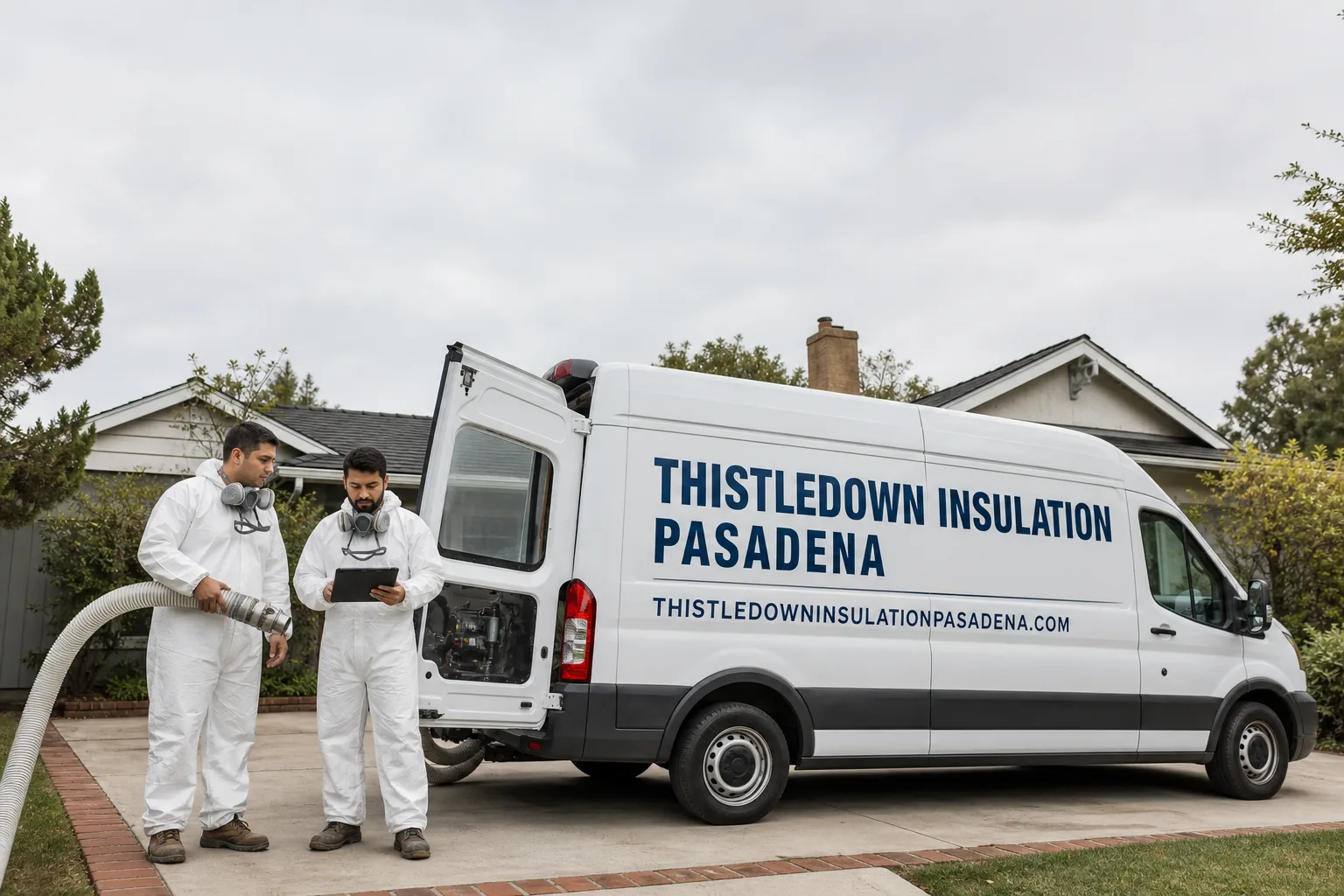
How Much Does Blown-In Insulation Cost in Pasadena?
Blown-in insulation in Pasadena typically costs between $1,800 and $4,600 for a standard attic in a 1,500 to 2,200 square foot home, or roughly $2.10 to $4.80 per square foot installed, including materials, labor, and air sealing. Most Pasadena homeowners we work with pay around $2,900 to $3,400 for a full attic project using fiberglass or cellulose blown to R-38. Your exact written number, never an estimate range, comes before we touch a single rafter.
Here’s what goes into that number, how Pasadena’s climate and housing stock affect the math, and where you can save without cutting corners that matter.
Key Takeaways: Blown-In Insulation Pricing in Pasadena
- Typical attic project: $1,800 to $4,600 depending on square footage, access, and product choice.
- Per-square-foot installed cost: $2.10 to $4.80 for most Pasadena attics.
- Reroof-facing homes: Many Pasadena houses built before 1978 need air sealing first, which runs $400 to $900 on average.
- Free estimates: We write your price before work starts, every time. Call us at (626) 657-5343.
Blown-In Insulation Cost Breakdown (2026)
Our pricing for the Pasadena market as of the 2026 season. These are real ranges pulled from jobs we’ve completed across Bungalow Heaven, Madison Heights, and the San Rafael Hills. Your specific number depends on what we see from the attic hatch, the HVAC chase, and the rim joists.
| Line Item | Typical Cost Range | What It Includes |
|---|---|---|
| Attic air sealing | $400 – $900 | Can lights, top plates, wire penetrations, plumbing stacks |
| Fiberglass blown-in (R-38) | $1,800 – $2,900 | Material and labor for 1,500 – 2,200 sq. ft. attic |
| Cellulose blown-in (R-38) | $2,100 – $3,300 | Material and labor, higher R-value per inch than fiberglass |
| Spray foam, open-cell (attic) | $4,000 – $7,200 | Includes air sealing in the application itself |
| Insulation removal and disposal | $1,500 – $3,800 | Old batt removal, vacuum truck, and disposal fees when rodent damage or moisture is present |
| Attic hatch insulation and weather stripping | $120 – $280 | Often the single most cost-effective add-on we recommend |
For the houses we see in Pasadena, the path to a $4,600 plus project is usually two things arriving at once: a home over 2,400 square feet, and an attic that needs the old material pulled before new goes in. The more common $2,900 to $3,400 range reflects a straightforward attic with access from an interior hallway, no moisture problems, and a family that wants an honest job done cleanly.
What drives a quote down: a clean, empty attic with an easy scuttle access. What drives it up: a low-pitch roof where our crew works from knee boards, or an attic with five separate perpendicular roof lines that make even distribution slow work. Those are real conditions, and they show up in the written price, not as a surprise line item after the fact.
What Affects Blown-In Insulation Pricing in Pasadena
- Square footage of your attic floor. Pasadena runs from compact California bungalows near the Rose Bowl at around 900 square feet of attic floor to larger two-story Spanish colonials in Annandale and the hills where the attic can stretch past 2,800 square feet. More rafter bays to fill means more material and more hours.
- Air sealing work that should happen first. Most Pasadena homes built before 1978 have recessed can lights, unsealed top plates, and gaps around furnace flues. Blowing insulation over those leaks buries the problem. We seal first, then insulate. The sealing itself is part of what makes the project effective, and it appears as its own line item.
- Product choice. Cellulose runs slightly higher than fiberglass per bag, but it has a higher R-value per inch and works well in Pasadena’s summer heat by slowing heat transfer through the ceiling plane. Fiberglass holds its loft well and is a common pick for families who want a proven product at a slightly lower cost.
- Condition of the existing attic. K&T wiring, old vermiculite, or a past rodent problem means we are pulling material out before new goes in. Removal and disposal costs are real and should be part of any honest quote, not hidden as an “oh by the way” on installation day.
- Roof geometry and attic access. A steep-roofed German-style home in the Highlands has attic bays that run in six directions. A low bungalow roof has two or three. More corners, hips, and valleys means our installers move slower and use more material to hit the target depth in every bay.
- Rebate timing. Pasadena Water and Power runs insulation rebate programs for its residential customers, and the available amount shifts year to year. We will tell you if a program is active when we come out, and we will show you the pre-rebate and post-rebate numbers in the same written price.
Pasadena Climate and Housing Stock: What It Means for the Cost
Pasadena sits in USDA Hardiness Zone 10a, which means hot, dry summers and nights that cool off once the sun drops below the San Gabriel Mountains. That daily swing is why R-38 in the attic matters more than most people think: the attic is where the day’s heat gets stored, and once the sun goes down, that stored heat pushes down into bedrooms for hours. A properly insulated and air-sealed attic slows that heat transfer, which means less load on the air conditioner during the 90-degree stretches we get in August and September.
Housing stock matters too. Pasadena has more than 30,000 single-family homes, and a large share were built between 1910 and 1950. Those homes have attics with true dimensional lumber, not modern trusses, and the bays are wider. That’s not a problem, it’s just a fact of the job: wider bays take more bags of material and a little more time to hit a consistent depth. We quote it the same way every time, by measuring the attic floor, not by estimating from the street.
How to Save on Blown-In Insulation
The honest answer is that the biggest savings come from doing the job right the first time and not paying twice to fix someone else’s shortcut. That said, here are the moves that actually lower a Pasadena insulation bill:
- Combine air sealing with the insulation. Air sealing costs $400 to $900 on average, but when done as part of an insulation install, the crew is already in the attic with the equipment up the ladder. Doing it later means a second mobilization, and that costs more.
- Check PWP rebates. Pasadena Water and Power has offered residential insulation rebates in most years, typically in the $0.10 to $0.25 per square foot range with a cap. The program parameters change, so call us at (626) 657-5343 and we will verify what is active before finalizing your quote.
- Pick the right product for your attic, not the cheapest. Cellulose costs slightly more up front but often performs better in Pasadena’s heat. If a home has a ducted HVAC system in the attic, spray foam may reduce energy loss enough to pay back the premium within a few years. The cheapest bid is rarely the cheapest outcome.
- Do not skip the hatch. An attic hatch without insulation is like leaving a 24 by 24 inch window open year round. Sealing and insulating the hatch runs $120 to $280, and it is one of the best dollars per square foot in the whole project.
- Get a written price from a company that does not change it. If a quote is a range, expect the invoice to land at the top. Our price goes in writing before we start, and it does not move unless you ask us to change the scope.
If you want to know exactly what your attic will cost, a free estimate is the fastest path. We answer the phone live, 24/7, at (626) 657-5343.
Pasadena Attic Insulation Cost by Common Home Profiles
These profiles reflect what we see driving around Pasadena neighborhoods like Normandie Heights, Oak Knoll, and the streets north of the 210. Specific numbers would still require a site visit, but these are the ranges that match the majority of homes in each category.
| Home Profile | Typical Attic Size | Cost Range (Installed, R-38) |
|---|---|---|
| California bungalow, 2-bed, 1-bath | 800 – 1,200 sq. ft. | $1,500 – $2,300 |
| Spanish colonial, 3-bed, 2-bath | 1,300 – 1,800 sq. ft. | $2,200 – $3,500 |
| Ranch home, 4-bed, 2-bath | 1,800 – 2,400 sq. ft. | $2,800 – $4,300 |
| Hillside home, 4+ bed (multi-level roof) | 2,200 – 3,200 sq. ft. | $3,600 – $5,800 |
What pushes a home into the higher end of its profile range: multiple roof planes, an attic with a furnace or ductwork we need to work around, or an access point in a closet rather than a hallway. None of these are deal-breakers. They are just factors we measure and put in the written quote, so you know before you commit.
Blown-In Insulation Brands We Install
We’re not tied to one manufacturer. Thistledown Insulation Pasadena installs blown-in products from Owens Corning, Johns Manville, Knauf, Rockwool, CertainTeed, and GreenFiber, and spray foam from Icynene and Demilec. The right product depends on your attic’s construction, whether you have ducts up there, and whether anyone in the house has sensitivities that make one material a better match than another. We choose pet-safe insulation products where a choice exists, so the dog can stay home during the job and the cats will not be displaced for the afternoon.
For homes near Pasadena’s mature oak canopies and older neighborhoods where dust mitigation matters, we often recommend a low-dust fiberglass product. For attics where thermal performance in August is the top priority, cellulose has a slight edge. We will walk you through the trade-offs, in plain English, at the estimate.
How the Thistledown Process Works
Every project we do follows the same sequence, and it starts before any money changes hands.
1. The Estimate Walk
We schedule a time that works for your family, including early mornings or evenings. The estimator wears shoe covers from the front door to the attic hatch and lays drop cloths across the hallway if the access is inside a closet or bedroom. We measure the attic floor, check the existing insulation depth and condition, note any air leaks, and take photos. You get a written price before we leave that visit.
2. On Installation Day
Our installers are background-checked and uniformed. They arrive with the material in labeled bags, the machine on wheels, and drop cloths for every surface between the door and the attic hatch. If air sealing is on the work order, it goes first. Then insulation goes in, bay by bay, until the depth rods show the target R-value in every section of the attic floor. We use quiet tools when children are sleeping, and we will ask before moving or touching anything in the house.
3. Clean Up, With Proof
Before the van pulls away, we take a photo of the cleaned work area. You get that photo. The Cedarwell Care Promise is not a slogan on a website. It is the standard for every visit: shoe covers, drop cloths, ask before touching, explain the price before the work, and clean up like it is our own home.
Thistledown is the soft fluff of the thistle, one of nature’s lightest insulators. The name is a reminder of how carefully we work.
Why Blown-In Choice Matters for Pasadena Homes
Blown-in insulation is the standard for Pasadena attics because of the way attics here are framed. Older bungalows and Spanish colonials have irregular bay spacing, shallow roof pitches, and areas behind knee walls that batts simply cannot fill without gaps and compression. Blown-in material flows into those spaces and creates a continuous thermal barrier, which matters more in Pasadena than a casual observer would think: our summer highs above 95 degrees, paired with warm nights, mean the attic holds heat for hours. A continuous R-38 layer slows that heat, and the difference shows up on the PWP bill and in the temperature of the bedrooms on the second floor.
What we see regularly in Normandie Heights and the neighborhoods north of the 210 is this: a 1940s attic with 2 inches of old rockwool, a fiberglass batt thrown over it in the 1990s, and gaps around every can light. The homeowner wonders why the upstairs bedroom never cools below 78 in July. The fix is not simply adding more material on top of a leaky attic. It is sealing the leaks and then blowing a consistent depth across the entire floor.
If you want to read more about the material itself and how it is installed, see Blown-In Insulation in Pasadena.
FAQs – Blown-In Insulation Cost
How much does blown-in insulation cost per square foot in Pasadena?
Installed blown-in insulation in Pasadena runs $2.10 to $4.80 per square foot of attic floor, including material, labor, and air sealing typical for the home. A 1,500-square-foot attic at R-38 usually costs between $2,600 and $3,600 total. For an exact figure, call (626) 657-5343, and we will measure and write a price you can keep.
Is it cheaper to repair or replace blown-in insulation?
If the existing material is dry, mold-free, and at least 6 inches deep, adding more blown-in fiberglass or cellulose on top typically costs $1.50 to $2.80 per square foot, which is cheaper than removal and reinstallation. But if there has been a roof leak, rodent activity, or visible compaction, replacement is the more honest and ultimately less expensive route because new material over compromised material fails early. We can tell you which path applies to your attic during a free estimate.
How long does a blown-in insulation job take in Pasadena?
Most Pasadena attic insulation projects take 4 to 7 hours from set-up to final clean-up photo, depending on attic size, access, and whether air sealing or removal is included. Smaller bungalow attics under 1,000 square feet can often be done in half a day, while larger hillside homes with complex roof lines may take a full day. We always clean up the same day and send a photo of the finished work area before we leave.
Does Pasadena Water and Power offer insulation rebates?
PWP has offered residential insulation rebates in most years, typically paying between $0.10 and $0.25 per square foot with a cap, though program terms and funding change annually. Our team checks current rebate availability before finalizing any quote, and the written price shows both the project cost and any eligible rebate. Call (626) 657-5343 and we will confirm what is active this year.
Does the crew wear shoe covers and protect our floors during installation?
Yes, every Thistledown Insulation Pasadena visit includes shoe covers from the front door to the attic hatch and drop cloths across every surface in between. We lay cloths down hallways and through any room where the access lives, and before the van leaves, we take a photo of the cleaned area so you can see the finished condition. This is the Cedarwell Care Promise on every job, not an add-on you have to request.
Get Your Pasadena Blown-In Insulation Price in Writing
You don’t have to guess what blown-in insulation will cost, and you should not have to. Call us at (626) 657-5343, and we will come out, measure your attic, check the condition of the existing insulation, and give you a written price before any work starts. No obligation, no pressure, no vague ranges that balloon on invoice day. A live person answers the phone, 24/7, and estimates are free.
We have been serving Pasadena homeowners since 2003 as an independently owned Cedarwell-family company, and every job is backed by our 365-Day Done Right Promise. If it is not done right, we make it right, without debate or fine print. Whether you live in Bungalow Heaven, Madison Heights, or up in the San Rafael Hills, we would be glad to help. Visit our home page to learn more about the Thistledown approach, or call now and talk to a real person.
Written by Neil Barron, Owner at Thistledown Insulation Pasadena, serving Pasadena since 2003.
Pricing reflects the Pasadena market as of 2026. Thistledown Insulation Pasadena offers free estimates – call (626) 657-5343.
What Our Customers Say
"Careful and clean from start to finish. They covered the hallway, wore booties, and hauled off all the old material without leaving a speck. Respectful of the home the whole time."
- Brett Yamamoto"Attic insulation. The crew laid down protection from the front door to the attic hatch and vacuumed up every bit of the old material. House holds its warmth now and there was zero mess."
- Rowena Platt"Attic insulation with a baby in the house. The crew was quiet, clean, and protected every floor they crossed. Took away all the debris and left it tidy. Already feeling the difference in comfort."
- Omar Leon